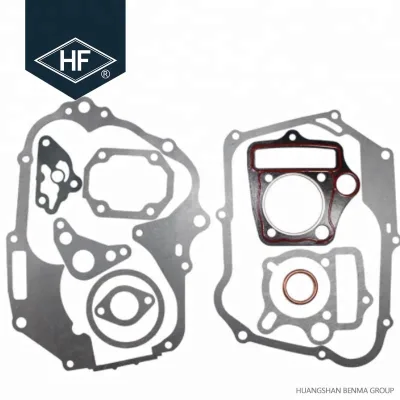
Source Four Stroke Motorcycle Cylinder Gasket for Engine Repair
Find and compare 30 listings for four stroke motorcycle cylinder gasket options suitable for engine, transmission, and rear axle applications. Review specifications for compression molding processes and OEM customization services to identify the right replacement parts for your needs; compare the available evidence and request quotations based on your requirements.
Key considerations
Products List




Comprehensive Sourcing Guide
Four Stroke Motorcycle Cylinder Gasket Sourcing Guide
Sourcing four stroke motorcycle cylinder gaskets requires careful attention to the specific engine architecture and the intended application, as these components are critical for sealing combustion chambers and preventing oil or coolant leaks. The available market data indicates a diverse range of models, including the 110 WAVE NEW, CLICK, and SHOGUN, suggesting that buyers must match gasket specifications precisely to the engine displacement and stroke type. Since the observed listings include both standard and nonstandard options, procurement teams should verify that the selected part aligns with the original equipment manufacturer's design to ensure proper fitment and performance.
Buyers must also navigate the variability in material composition and customization services offered by suppliers, as some listings specify rubber while others mention asbestos, a material that requires strict handling protocols. The presence of OEM and ODM services allows for tailored solutions, yet the condition of the product is consistently listed as new, which is essential for replacement and repair scenarios. Understanding these distinctions helps in selecting the right supplier who can provide the necessary customization, such as specific logos or packaging, while maintaining the integrity of the gasket's sealing capabilities.
Product Scope and Observed Listing Signals
The product scope for four stroke motorcycle cylinder gaskets encompasses a wide array of applications, ranging from engine and transmission systems to rear axle and front axle assemblies, though the primary function remains sealing the cylinder head. Observed listing signals reveal that models like the AX4, BC175, and BLITS125 are commonly associated with these gaskets, indicating a broad compatibility with various motorcycle platforms. The data also highlights that these parts are designed for replace and repair purposes, ensuring that fleet operators and individual mechanics can maintain vehicle performance without needing to replace the entire engine block.
Listing signals further indicate that packaging varies significantly, with options ranging from bulk packing to netual packing, and even customized blister cards or cartons depending on the supplier's service level. This variability suggests that buyers should explicitly define their packaging requirements during the inquiry phase to avoid logistical mismatches. Additionally, the observation of specific model numbers like NWSR and CHCSR-17 alongside generic descriptions implies that some suppliers may offer proprietary designs or specific fits that require careful verification against the motorcycle's service manual to ensure compatibility.
Technical Specifications to Verify
Verifying technical specifications is paramount when sourcing these gaskets, particularly regarding the molding process and material composition, as these factors directly influence durability and heat resistance. The observed data points to compression and injection molding as the primary manufacturing processes, which can affect the gasket's density and sealing consistency. Buyers should confirm whether the material is rubber or asbestos, as this distinction impacts safety compliance and environmental regulations, especially in markets with strict emissions and health standards.
Furthermore, the verification of dimensional accuracy is critical, as the observed listings mention standard sizes alongside specific model codes like 250Z and NEW WAVE. Since the stroke is consistently noted as four stroke and the cooling style as air-cooled, the gasket must withstand the thermal cycles associated with these engine types without degrading. Buyers should request detailed dimensional drawings or samples to ensure that the gasket fits the specific cylinder head geometry, preventing issues such as blow-by or oil leakage that could compromise engine efficiency and longevity.
Compliance and Safety Documentation
Compliance and safety documentation are essential components of the procurement process, given the presence of certifications such as IATF16949, ISO, Reach, RoHS, and MSDS in the observed listings. These certifications indicate that the supplier adheres to international quality management and environmental standards, which is crucial for importing gaskets into regulated markets. Buyers must ensure that the specific gasket model they intend to purchase is covered under these certifications, as a supplier may hold general company certifications that do not automatically extend to every product variant or material type.
Safety documentation is particularly important when dealing with materials like asbestos, which may be listed in some product descriptions, requiring strict adherence to handling and disposal regulations. The presence of LFGB and F D a certifications suggests that some products may be intended for applications with food contact or specific safety requirements, although this is less common for engine gaskets. Buyers should request the latest test reports and safety data sheets to verify that the gasket meets the specific regulatory requirements of their target market, ensuring that the product is safe for use and does not pose health risks to mechanics or end-users.
Cost Drivers and Commercial Terms
Cost drivers for four stroke motorcycle cylinder gaskets include the complexity of the molding process, the choice of material, and the level of customization required, such as custom logos or specific packaging. The observed price range of 0.01 to 10 USD suggests a wide variance based on these factors, with higher costs likely associated with specialized materials or complex designs. Buyers should analyze the total cost of ownership, considering that lower-priced items may compromise on material quality or durability, potentially leading to higher replacement costs and downtime.
Commercial terms such as minimum order quantities (MOQ) and lead times are also significant cost drivers, with observed MOQs ranging from 1 to 2000 units and lead times between 10 to 20 days or 15 to 30 days depending on the supplier. The availability of sample times ranging from 3 to 7 days allows buyers to validate product quality before committing to larger orders, which can mitigate financial risk. Buyers should negotiate terms that balance cost efficiency with supply chain reliability, ensuring that the supplier can meet demand fluctuations without compromising on delivery schedules or product consistency.
Supplier Qualification and Quality Control
Supplier qualification involves a rigorous assessment of the manufacturer's capabilities, including their adherence to standards like ISO9001 and their ability to provide consistent quality across different product lines. The observed data indicates that suppliers offer services such as 3D design and custom packaging, which suggests a level of technical sophistication that should be verified through site audits or third-party quality assessments. Buyers should prioritize suppliers who demonstrate a clear commitment to quality control, as this reduces the risk of receiving defective gaskets that could lead to engine failures.
Quality control measures should include regular testing of material properties and dimensional accuracy, ensuring that the gaskets meet the specified standards for compression and injection molding. The presence of certifications like GS and IATF16949 provides a baseline for quality, but buyers should also request specific test results for the gasket models they intend to purchase. Establishing a robust quality control protocol with the supplier, including regular inspections and feedback loops, is essential for maintaining product consistency and ensuring that the gaskets perform reliably in the demanding environment of a four stroke motorcycle engine.
Long-Term Procurement Checks
Long-term procurement checks focus on maintaining a stable supply chain and ensuring that the supplier can consistently meet evolving market demands and regulatory changes. Buyers should establish periodic review mechanisms to assess the supplier's performance, including their ability to maintain lead times, manage inventory, and adapt to new material or design requirements. The observed data suggests that suppliers offer one-stop sourcing, which can simplify the procurement process, but buyers must verify that this convenience does not come at the expense of quality or reliability.
Additionally, long-term checks should include monitoring the supplier's compliance with changing environmental and safety regulations, as standards like Reach and RoHS are subject to updates. Buyers should maintain open communication channels with suppliers to stay informed about any changes in product specifications or manufacturing processes that could impact the gasket's performance. By proactively managing these relationships and conducting regular audits, buyers can ensure a sustainable supply of high-quality four stroke motorcycle cylinder gaskets that meet the needs of their customers and comply with all relevant regulations.
FAQs
What materials are used for four stroke motorcycle cylinder gaskets?
Four stroke motorcycle cylinder gaskets are typically manufactured from rubber or asbestos to ensure effective sealing and heat resistance. These materials are selected for their durability under high-pressure engine conditions. Buyers can often request specific colors such as grey, green, yellow, or blue to match their assembly requirements or branding preferences.
Can I get custom packaging for these gaskets?
Yes, customization is available for packaging. Suppliers offer options including bulk packing, neutral packing, cartons, blister cards, bags, or customized branding. OEM packaging is also supported, allowing buyers to display their own brand identity. This flexibility helps protect the gaskets during transit and enhances the final product presentation for end consumers.
What certifications do these gasket manufacturers hold?
Manufacturers typically hold IATF16949, ISO, Reach, RoHS, MSDS, LFGB, and GS certifications. These credentials verify compliance with international quality and safety standards. Such certifications ensure that the gaskets meet rigorous automotive and motorcycle industry requirements, providing buyers with confidence in the product's reliability and the supplier's operational standards.
How long does production take for these gaskets?
Production lead time generally ranges from 10 to 20 days after order confirmation. Sample preparation takes approximately 3 to 7 days. Delivery times may extend to 15-30 days depending on order volume and logistics. Buyers should plan their inventory accordingly to ensure timely availability for their assembly lines or repair services.
Which motorcycle models are compatible with these gaskets?
These gaskets are designed for various models including CLICK, 110 WAVE NEW, AX4, NEW WAVE, BC175, 250Z, BLITS125, and SHOGUN. They serve as replacements or repairs for engine, transmission, and rear axle components. The standard size ensures broad compatibility with common four-stroke motorcycle engines.
What is the minimum order quantity for these gaskets?
The minimum order quantity ranges from 1 to 2000 units, offering flexibility for both small and large buyers. This wide MOQ range accommodates diverse procurement needs, from individual repair shops to large-scale distributors. Buyers can negotiate specific quantities based on their inventory requirements and budget constraints.